
Tables are being turned this fall on College of Health Sciences students usually more accustomed to focusing on athletes on game day than being in the spotlight themselves.
The reason? The Athletic Training Program is marking a half-century of teaching, training and turning out top-notch professionals who land jobs often before graduating.
The gridiron connection is a natural; Boise State Athletics has helped to shape the Athletic Training Program from the beginning. Students benefit from classes and clinical rotations connected to the powerhouse sports program, and faculty members and administrators freely collaborate, sharing ideas and resources that have, among other things, led to plum jobs and assignments for graduates across the globe.

Dave Hammons directs the program and is an associate professor in the COHS’ School of Kinesiology. He credits Ron Pfeiffer, the first program director, and Gary Craner, retired Boise State Athletics head athletic trainer, with establishing what has become a go-to program for dozens of professional sports teams, clinics, schools and businesses looking to hire well-prepared athletic trainers. Craner, Hammons points out, also taught kinesiology courses, as did his assistants.
Continually growing but high quality education remains consistent
The kinesiology curriculum was foundational in those early years. In the beginning, there was an undergraduate program that served as the kinesiology core program of study. Students learned the fundamentals and application of athletic injury, taping, bracing and therapeutic modalities.
The program now presupposes a bachelor’s degree, and serves masters-level students with a rigorous 50-credit-hour training program spread across about two-dozen classes. Students continue to experience significant hands-on, clinical practice, often in the Boise State Athletics context. Boise State Athletic Training was accredited in 1982, the year national accreditation began.
“It became more robust, and Boise State has maintained continuous accreditation since 1982,” Hammons said. “It has been a very successful program.”
Where do athletic trainers work?

Graduates historically moved on to positions in what might be termed “traditional settings” primarily as college and professional athletic trainers. The field has expanded considerably over the years, however, and program graduates can now be found at high schools, in outpatient rehabilitation clinics, working with youth sports clubs and local sports programs.
Boise State-trained, certified athletic trainers work on musculoskeletal injuries and illnesses, design and develop physical rehabilitation programs, work with orthopedic surgeons and see patients on an outpatient basis, along with working alongside sports medicine specialists as physician extenders. Regionally, they work at St. Luke’s Health System, Saint Alphonsus and other healthcare entities; they’re a fixture at rodeos, Ironman competitions and a myriad of other competitive athletic events.
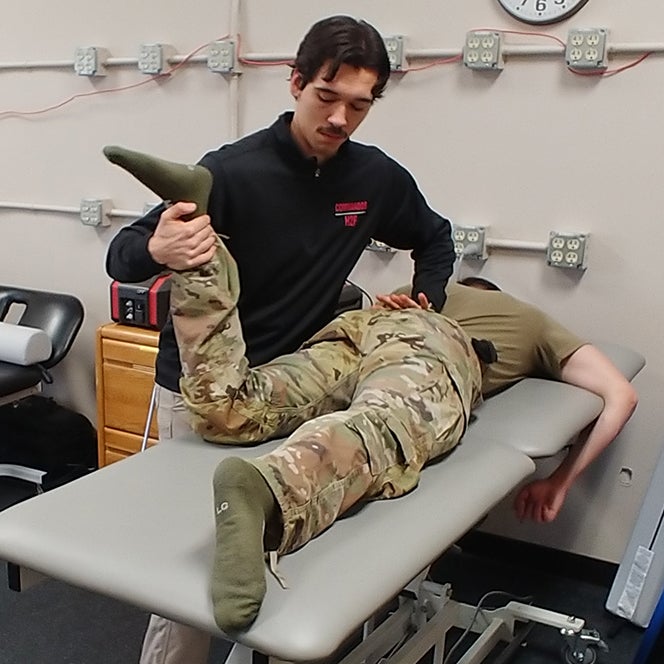
Increasingly, they also are going to work for big companies in industrial settings; Boeing and Amazon are just two of the companies that have hired Boise State kinesiology grads. The military also has seen the value of staff athletic trainers who can be at the ready to treat personnel.
“They have found that the return on investment is really remarkable,” Hammons said.
Consistent Student Success
The same could be said for students. The program boasts a 95 percent placement rate at graduation, and hit 100 percent this past spring; most program participants have jobs before they graduate. The students who have not secured positions in the field at graduation, for the most part, have opted to go on to medical school or physician assistant or other programs, Hammons said. The first-time board of certification pass rate among graduates is 90.5 percent; the national average is 70.5 percent.

From the beginning, the program has been flexible, responsive and focused on ensuring participants can jump into professional settings, Hammons said.
“Overall, it’s just our progressive nature from day one of the program, and going back and reassessing to make sure students not only understand the material, but know how to apply it.”
What does the future of athletic training look like?
As the Athletic Training Program heads into its second half-century, Hammons envisions elements that will build out skills and knowledge having to do with the business and entrepreneurial aspects of the field.
“It could be that we say, ‘Hey, it’s very possible for you to be a stand-alone provider in your own clinic,’” he said. “That’s not commonplace in athletic training right now.”
Some things won’t change, though.
“We’re never going to lose sight of our history in athletic training,” Hammons said. “That’s one thing that’s central to me as the program director, along with working with Athletics. They respect the academic side, too, and really take ownership in mentoring future athletic trainers. That is really important to me, and it has been with the previous program directors.”
And because students benefit from program affiliations with about 40 clinical sites around the Treasure Valley, Athletic Training Program participants often need no introduction; they may have worked with young athletes in sports programs and later see them as patients in a clinic or professional sports setting. The effect also can ripple out more broadly, as grads take positions outside the Gem State.