Launched in 2023 with $2 million in Department of Energy (DOE) funding, the Common Ground Consortium established a “network of networks” spanning nine core organizations alongside industry, Tribal, government, and academic partners. The initiative connected local communities, state policymakers, and technical experts to advance collaboration-based siting for used nuclear fuel and related infrastructure. To broaden regional impact, Common Ground deployed $1 million in sub-award infrastructure, including over $200,000 in competitive seed grants.
Led by Boise State University’s Energy Policy Institute, the project’s primary goal has been to provide recommendations to the U.S. Department of Energy on the design for effective and fair processes. Drawing on historical lessons and ongoing feedback, the initiative engages with communities, Tribal groups, industry leaders, policymakers, and technical experts to develop guidance.
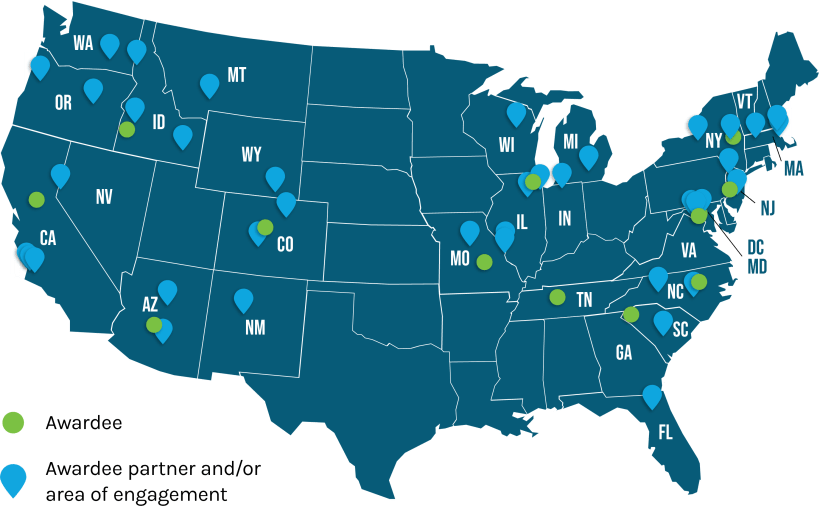
As one of twelve consortia (see map) designated by the U.S. Department of Energy, Common Ground serves as a networked educational, research, and advising hub. Each consortium focuses on its uniquely proposed area of inquiry.
Major participants
Common Ground is a partnership of nine universities and the National Tribal Energy Association (NTEA), with additional cross-sectoral partners from government, industry and academia. This hub includes Arizona State, Boise State, Colorado State, Idaho State, Montana State, University of Idaho, University of Wyoming, University of Michigan, Utah State University, plus NTEA. Additional partners include the National Association of State Energy Officials, Nuclear Energy Institute, Nuclear Waste Strategy Coalition, Western Interstate Energy Board, Alaska Conservation Foundation, and Institute for Inclusive and Transformative Scholarship to ensure that State, industry, and key groups are factored.
Seed Grant Program
The seed grant programming supported research and public feedback sessions on collaborative, public engagement and decision-making processes tied to siting of critical infrastructure.
Awardees
Awardees advanced understanding across sectors and varied types of critical infrastructure.
Utah State University was awarded funds to investigate how community health and wellbeing can be integrated into community engagement and collaborative siting for future energy infrastructure projects in coal communities experiencing change in Utah’s Carbon and Emery counties.
Alaska Conservation Foundation (ACF) was awarded funds to examine consent in the critical minerals mining sector. Partnering with the Alaska Mining Impacts Network (AKMIN), ACF investigated the decision-making implications of consent vs. consultation.
Methods
The project employs a strategy to improve approaches for engagement and decision-making for different kinds of communities across geography, experience, and sector. It utilizes the strengths of case analysis, focus groups, historical record review and expert elicitation for briefings. Mutual gains approaches, Delphi ranking and pairwise comparisons inform discussions.
Key Outcomes of the Consortium Activities

- Socio-Technical Research: The project combines historical case studies with surveys, focus groups, and expert elicitation to examine complexities under the Nuclear Waste Policy Act (NWPA).
- Articles and papers for communities, policymakers & industry
- Improved understanding across geography and sector from different stakeholders. Common Ground hosted in-person workshops around Idaho and Colorado; a forum with state energy officials and public utility regulators; and virtual webinar/speaker events reaching 1,000+ registrants.
- Identification of better practices and recommendations
- More informed training and writing – To date, we have educated ~245 students across seven regional universities through courses spanning risk communication, security regulation, fuel cycles, and energy geography.
For questions, contact us at epi@boisestate.edu. This webpage is periodically updated. Last update: July 2026.
Additional Information
- Stoellinger, T., Araújo, K., Harder, V., Gerace, S., and Armstrong, M. “Operationalizing Adoption Readiness in Spent Nuclear Fuel Siting: Legal Reforms to Design for Progress,” Environmental Law Reporter, September 2026.
- Araújo, K. 2026. From Stalemate to Collaboration: Rethinking Nuclear Waste Siting and Policy. Waste Management Symposia Conference.
- Koerner, C. and R. A. Borrelli. 2025. A Collaborative-Based Siting Case Study of Yucca Mountain Siting: The Willrich Report Predictions. Proceedings of the International High Level Radioactive Waste Management Conference. p. 206-209.
- Borrelli, R. A., Araújo, K., Koerner, C. and D. Djokić. 2024. Consent based siting for Spent Nuclear Fuel – The Common Ground Consortium Focus on Research and Public Conversations. Transactions of the American Nuclear Society, 130 (1): 80-83.
- Smutko, L. S. 2025. Collaborative Siting Process for Critical Energy Infrastructure. Common Ground, Guidance Resource.
- Sample Decision Tree. Common Ground, Guidance Resource.
- Public Feedback, Common Ground Consortium, 2024.