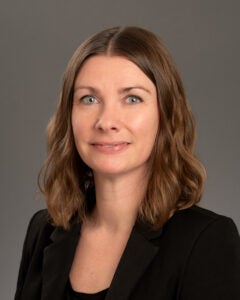
Assistant Professor of Neurosciences,
Department of Biological Sciences
- Year arrived at Boise State University: 2024
- Email: LaurenFaget@boisestate.edu
- Office: Science Building, Room 102B
- Lab: Science Building, Room 241
- Zoom Phone: (208)426-6355
- Mailing Address:
Department of Biological Sciences
Boise State University
1910 University Dr.
Boise, ID 83725-1515
Teaching
- BIOL117 – Introduction to Neuroscience
- BIOL 497 – Advanced Topics in Behavioral Neuroscience
Academic Degrees
- Doctor of Philosophy, Neurosciences, 2010
University of Strasbourg, France
Advisors: Brigitte L. Kieffer and Dominique Massotte - Master of Science, Psychopharmacology, 2007
University of Bordeaux, France - Bachelor of Science, Biological Sciences, 2005
University of Bordeaux, France
Positions
- 2024-present: Assistant Professor, Department of Biological Sciences, Boise State University, Idaho
- 2022-2024: Research Health Scientist, VA Medical Center ‐ Research Department, San Diego, California
- 2017-2024: Project Scientist, department of Neurosciences, UC San Diego, California
- 2013-2017: Postdoctoral Fellow, Hnasko Lab, department of Neurosciences, UC San Diego, California
- 2010-2012: Postdoctoral Fellow, Kieffer lab, IGBMC, Strasbourg, France
Honors and Awards
- 2021-22: UCSD Health Sciences Academic Senate research award
- 2016: Attias Family Foundation Investigator
- 2015-17: 2014 NARSAD Young Investigator Grant from the Brain & Behavior research foundation
- 2010: Travel Award, FENS Forum, European Society for Neuroscience
- 2007-10: IGBMC international Ph.D. program fellowship, “Paul Mandel” promotion
- 2007-10: Region Alsace Ph.D. fellowship
More Information
Research Interests
My research goals are to dissect brain circuits that control motivated behaviors and to investigate the adaptation and dysregulation occurring in these circuits when reward processes get altered (e.g., avolition, anhedonia, negative affective state, compulsive behavior), hallmark symptoms of neuropsychiatric disorders such as drug addiction, schizophrenia or depression. Towards this goal my lab deploys a wide range of assays, techniques and tools, including mouse behavioral assays, viral-mediated gene transfer, genetically-modified mice, optogenetics for in vivo neuronal manipulation, fiber photometry for in vivo calcium imaging, MATLAB and Python coding for big data analysis, histology, in situ hybridization, immunohistochemistry and microscopy