Kenneth Elzinga
“Adam Smith’s Obvious and Simple System of Natural Liberty”
Thursday, February 13, 2025
6:30 p.m.
Jordan Ballroom, Student Union Building
The lecture is free and open to the public
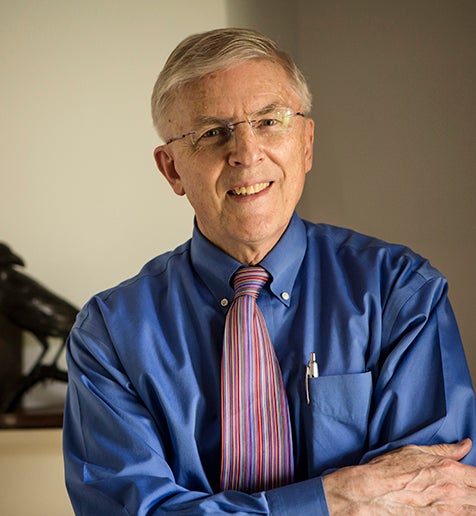
Kenneth Elzinga is the Robert C. Taylor Professor of Economics at the University of Virginia. He has received numerous teaching awards, and each fall his introductory economics course attracts more than a thousand students, making it the largest class offered at the University of Virginia.
An expert in antitrust economics, he has testified in several precedent-setting antitrust cases, including three Supreme Court decisions.
The author of more than 100 academic publications, Elzinga also is known for his mystery novels, some co-authored with William Breit (under the pen name Marshall Jevons), in which the protagonist employs economic analysis to solve crimes.
Elzinga has a B.A. and honorary doctorate from Kalamazoo College and a Ph.D. from Michigan State University. He has been a member of the faculty at the University of Virginia since 1967.
Learn more about Kenneth Elzinga.
The Purpose of the Adam Smith Lecture Series
The Department of Economics established the Adam Smith Lecture Series to bring to the Boise State campus nationally and internationally recognized scholars who have deepened our understanding of and extended the work of Adam Smith.
Adam Smith, the 18th century Scottish moral philosopher, established his reputation with two works, “The Theory of Moral Sentiments” and “The Wealth of Nations,” which continue to enlighten and inform us concerning the two spheres of interaction that humans engage in: first, the intimate sphere of personal exchange typified by friendships, family, and voluntary non-market institutions such as churches and clubs; second, the impersonal sphere of market exchange, which gives occasion to the specialization and division of labor that has produced the wealth we enjoy as modern citizens of the world, in those nations that have embraced markets and the necessary underlying institutions of the rule of law and private property.
Adam Smith Lectures are free and open to the public.
Closed captions are available and transcripts are accessible at YouTube: Adam Smith Lecture Series (click “…more” in the description field, then click “Show transcript”).
Play the Videos of Past Lectures
Past Speakers
2024 – Daniel B. Klein
“Commanding Passions: Adam Smith on Self-Command”
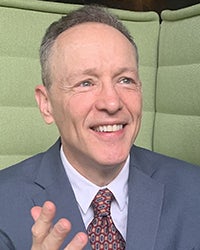
Klein’s title, “Commanding Passions,” might be understood as: the commanding of passions. But another understanding is also important: the passions that do the commanding.
Klein holds degrees from George Mason University and New York University, where in both cases he studied the classical liberal traditions of economics. His teaching focuses on economic principles and public policy issues. He is the author of “Knowledge and Coordination: A Liberal Interpretation,” he coauthored “Curb Rights: A Foundation for Free Enterprise in Urban Transit,” editor of “Reputation: Studies in the Voluntary Elicitation of Good Conduct,” and editor of “What Do Economists Contribute?” Klein posted about his Boise State lecture on the George Mason Adam Smith Program website. Learn more about Daniel B. Klein.
2023 – Sandra Peart
“Analytical Egalitarianism and Race: From Adam Smith to John Stuart Mill”
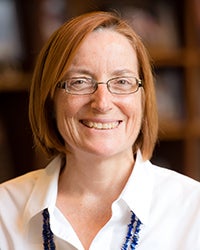
Sandra Peart is the dean and E. Claiborne Robins Distinguished Professor in leadership studies at the University of Richmond and past president of the International Adam Smith Society. Peart discuses the role that analytical egalitarianism — the view that in analyzing behavior all people are to be treated as equals — played in the theories of the classical economists, including its relationship to questions of race, ethnicity, slavery, equality and immigration. Learn more about Sandra Peart.
Watch “Analytical Egalitarianism and Race: From Adam Smith to John Stuart Mill.”
2022 – Bart Wilson
“The Purpose of Property: Experimental Evidence on Adam Smith’s Insights”
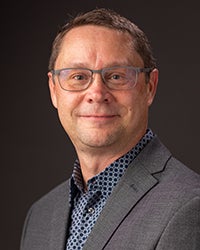
Bart Wilson is a professor, the Donald P. Kennedy Chair in Economics and Law and the director of the Adam Smith Institute for Political Economy and Philosophy at Chapman University. He is a leading practitioner of experimental economics, testing economic ideas in the laboratory, and co-author with Nobel Laureate Vernon Smith of “Humanomics: Moral Sentiments and the Wealth of Nations for the Twenty-First Century” and author of “The Property Species: Mine, Yours, and the Human Mind.” Learn more about Bart Wilson.
Watch “The Purpose of Property: Experimental Evidence on Adam Smith’s Insights.”
2020 – Maria Pia Paganelli
“Why Read ‘The Wealth of Nations’”
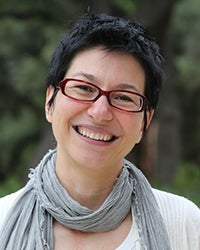
Maria Pia Paganelli is one of the world’s leading scholars on Adam Smith, and in January 2020 she was elected as president of the International Adam Smith Society and is a professor of economics at Trinity University, San Antonio, Texas. Learn more about Maria Pia Paganelli.
2019 – James Otteson
“Adam Smith on Justice and Social Justice”
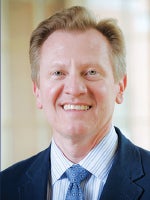
Otteson has a doctorate in philosophy from the University of Chicago, has taught at Yeshiva University and the University of Alabama, and is currently the Thomas W. Smith Presidential Chair in Business Ethics, Professor of Economics, and Executive Director of the Eudaimonia Institute at Wake Forest University. Learn more about James Otteson.
2018 – Samuel Fleischacker
“Being me, being you: Adam Smith on empathy, perspective and humanity”
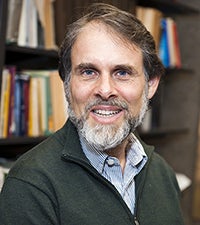
Samuel Fleischacker is the LAS Distinguished Professor of Philosophy at the University of Illinois-Chicago and author of “On Adam Smith’s Wealth of Nations: A Philosophical Companion.” He studied at Yale University, receiving his Ph.D. in 1989. He works in moral and political philosophy, the history of philosophy, aesthetics and the philosophy of religion. Among the issues that have particularly interested him are the moral status of culture, the nature and history of liberalism, and the relationship between moral and other values (aesthetic values, religious values, political values). Learn more about Samuel Fleischacker.
Watch “Being Me, Being You: Adam Smith on Empathy, Perspective and Humanity.”
2017 – Vernon L. Smith
“Moral Sentiments and the Wealth of Nations”
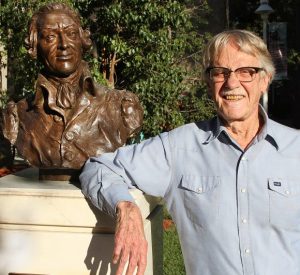
Vernon Smith is the 2002 Nobel Laureate in Economic Sciences and the George L. Argyros Endowed Chair in Finance and Economics, Chapman University.
The lecture focuses on Smith’s work in experimental economics investigating the connection between our moral sentiments towards others and how that relates to both non-market cooperation oriented toward common goals and market cooperation through exchange achieving individually separate goals.