Room-Temperature Molecular Excitonic Applications

DNA-Templated Dye Aggregates for Room-Temperature Quantum Entanglement and Quantum Information Applications

We computationally screen a wide range of dyes using an integrated approach that combines ab initio calculations, molecular dynamics, and machine learning. This allows us to predict both ground- and excited-state properties, uncover structure–property relationships, and gain fundamental insight into the role of quantum entanglement. We further investigate how hydrophobicity and polarity influence dye behavior in the context of quantum-coherent excitonic devices. Building on these insights, we design excitonic transmission lines and quantum gates based on dye aggregates organized by DNA scaffolds, enabling applications in universal quantum computation.

3D molecular model of DNA with color-coded strands (blue, red, yellow, green, orange) forming a double helix.
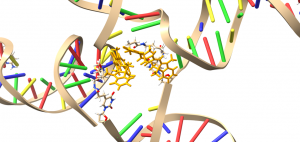
3D model of a DNA double helix with beige ribbon strands and colored rods (red, green, blue, yellow) representing base pairs; black molecular structures depict the chemical components of nucleotide bases.

In collaboration with the Quantum DNA Research Group