World-Class labs. Right here in Boise.

MSMSE students and researchers have access to some of the most advanced materials characterization and fabrication equipment in the Pacific Northwest.

Shared Use Instrumentation Facilities

Open to Boise State and External Users

MSMSE operates and participates in shared-use instrumentation facilities open to research across Boise State and to external academic and industry users. Each facility offers specialized equipment, trained staff support, and fee-for-service access.

Boise State Center for Materials Characterization (BSCMC)

The BSCMC is Boise State’s primary hub for materials characterization, housing two specialized labs with complementary capabilities. Whether you need to image a surface at the nanoscale or probe the chemical composition of a thin film, BSCMC has the tools and expertise to support your research.

Visit the BSCMC website

Surface Science Lab (SSL)

Surface and thin film characterization including XPS, AFM, and related techniques. Supports research in semiconductor processing, coatings, corrosion, and surface chemistry.

Visit the SSL website

X-Ray and Electron Microscopy Lab (XEML)

Scanning and transmission electron microscopy, X-ray diffraction, and elemental analysis. Used for microstructure characterization, phase identification, and defect analysis across all material classes.

Visit the XEML website

Idaho Microfabrication Laboratory (IML)

A shared-use advanced manufacturing facility supporting research, development, and prototyping across Boise State and with industry partners. The IML houses equipment for additive manufacturing, machining, and materials processing.

Visit the IML website

Looking for a specific piece of equipment?

Browse the full MSMSE Equipment Database to search by instrument type, capability, location, and availability across all MSMSE facilities.

View the Equipment Database

Services

MSMSE offers fee-for-service access to analytical, testing, and processing capabilities across multiple facilities on campus and at partner sites. Services are available to Boise State researchers, external academic institutions, and industry partners.

Structural Characterization

Boise State Researchers have access to a range of equipment and techniques including:

  • Transmission electron microscopy (TEM)
  • X-ray diffraction (XRD)
  • Scanning electron microscopy (SEM)
  • Systems equipped with energy dispersive spectroscopy
(EDS) and electron backscatter diffraction (EBSD)
  • X-ray photoelectron spectroscopy (XPS)
  • Nuclear magnetic resonance (NMR)
  • Isotope dilution thermal ion mass spectrometer (ID-
TIMS)
  • Atomic force microscopy (AFM)
  • Laser ablation inductively coupled plasma mass
spectrometry (LA-ICPMS)
  • Raman spectroscopy

Electrical and Magnetic Characterization

Boise State’s unique electrical properties characterization relies on an several semiconductor characterization set-ups, one of which allows testing at temperatures under 20 K. For magnetic property measurements, Boise State has a vibrating sample magnetometer (VSM) with temperature control and thin film capabilities.

Materials Processing

Boise State has a number of unique materials processing facilities including spark plasma sintering, hot pressing, a rapid prototype lab, a ceramic MEMS processing lab, a microfabrication center for semiconductor processing, numerous sputtering systems for thin film processing, high energy ball milling for powder processing, a tape casting setup, several high temperature controlled atmosphere furnaces, and inert atmosphere gloveboxes.

Mechanical Testing

Boise State’s mechanical testing capabilities include a hydraulic MTS load frame with high temperature testing capabilities, a bench-top hydraulic MTS load frame, a Zwick test bench for low load testing, microhardness systems, and nanoindentation. At CAES, several hydraulic load frames, a drop weight impact testing system, and microhardness
indenter are available.

Thermo-physical Property Measurement

Thermo-physical properties can be studied at Boise State using differential scanning calorimetry (DSC), differential thermal analysis (DTA), thermogravimetric analysis (TGA), combustion element analysis, and electrochemical corrosion analysis

Thin Film Characterization

To characterize thin film properties, Boise State researchers use optical profilometry and an x-ray reflectometry system for substrate curvature measurement device.

Do you need access to MSMSE equipment or services?

Are you interested in the services we provide? Please contact the Micron School of Materials Science and Engineering at materials@boisestate.edu. We are happy to point you in the correct direction so you can get started.

Find MSMSE on the Boise State Campus

MSMSE faculty, staff, and research labs are distributed across four buildings on the Boise State campus. Use the links below to find the right building for your visit, class, or research group.

  • The exterior of the Micron Center for Materials Research building

    Micron Center for Materials Research

    The Micron Center for Materials Research houses the MSMSE main office (Suite 207), the majority of faculty and staff offices, and several research labs in the new facility, opened August 2020.

    The Micron Center for Materials Research houses the MSMSE main office (Suite 207), the majority of faculty and staff offices, and several research labs in the new facility, opened August 2020.

  • Exterior of the Ruch Engineering building

    Charles P. Ruch Engineering Building

    The RUCH Engineering building is the location of several College of Engineering departments. Many engineering classes are taught in this building that brings together classrooms, offices, and research labs. Portions of the Boise State Center for Materials Characterization along with other research facilities can be found here.

    The RUCH Engineering building is the location of several College of Engineering departments. Many engineering classes are taught in this building that brings together classrooms, offices, and research labs. Portions of the Boise State Center for Materials Characterization along with other research facilities can be found here.

  • Exterior of the Micron Engineering Center

    Micron Engineering Center

    One of the four main buildings on campus for engineering students, this building also hosts many engineering classes, as well as several MSE research groups and staff/student offices.

    1020 S. Manitou Avenue

    One of the four main buildings on campus for engineering students, this building also hosts many engineering classes, as well as several MSE research groups and staff/student offices.

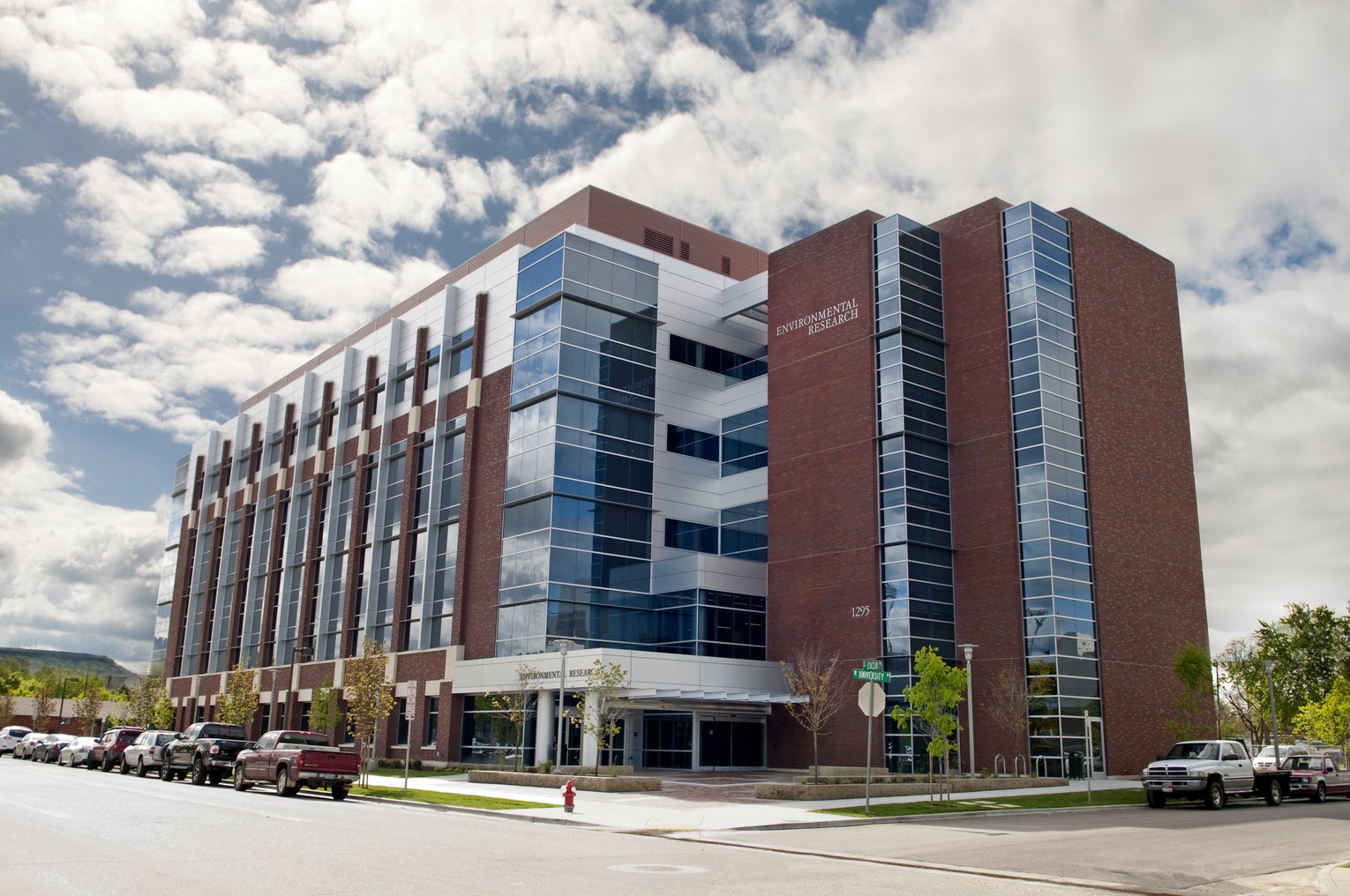
  • Exterior of the Environmental Research Building

    Environmental Research Building

    The Environmental Research Building is home to Boise State’s departments of Geosciences, Civil Engineering, Public Policy and Administration, and Political Science. Research labs including the CMELab, ANML, and MML utilize this facility.

    The Environmental Research Building is home to Boise State’s departments of Geosciences, Civil Engineering, Public Policy and Administration, and Political Science. Research labs including the CMELab, ANML, and MML utilize this facility.